
PARENTS: KEEP YOUR KIDS AWAY FROM FDA APPROVED DRUGS
mjvspharmies

Deaths from Marijuana v. 17 FDA-Approved Drugs
(Jan. 1, 1997 to June 30, 2005)

  1. Background
  2. Cause of Death Categories & Definitions
  3. FDA Disclaimer of Information
  4. Summary of Deaths by Drug Classification
  5. Deaths from Marijuana & 17 FDA-Approved Drugs
  6. Sources & Disagreement on Marijuana Deaths
  7. Full Text of All 17 FDA “Adverse Event” Reports

I. Background

Much of the medical marijuana discussion has focused on the safety of marijuana compared to the safety of FDA-approved drugs. On June 24, 2005 ProCon.org sent a Freedom of Information Act (FOIA) request to the US Food and Drug Administration (FDA) to find the number of deaths caused by marijuana compared to the number of deaths caused by 17 FDA-approved drugs. Twelve of these FDA-approved drugs were chosen because they are commonly prescribed in place of medical marijuana, while the remaining five FDA-approved drugs were randomly selected because they are widely used and recognized by the general public.

We chose Jan. 1, 1997 as our starting date as it is the beginning of the first year following the Nov. 1996 approval of the first state medical marijuana laws (such as California’s Proposition 215). The FDA reports we read from Sep. 13, 2005 to Oct. 14, 2005 included drug deaths “to present”, which was the date each report was compiled for our request. We cut off the counting as of June 30, 2005 to provide a uniform end-date to the various reports.

On Aug. 25, 2005 the FDA sent us 12 CDs and five printed reports containing copies of their Adverse Event Reporting System (AERS) report on each drug requested. These reports included all adverse events reported to the FDA, only a portion of which included deaths. We manually counted the number of deaths reported on each drug from the FDA-supplied information.

A review of the FDA Adverse Events reports also revealed some deaths where marijuana was at least a concomitant drug (a drug also used at the time of death) in some cases. On Oct. 14, 2005 we used the Freedom of Information Act to request a copy of the adverse events reported deaths for marijuana/cannabis. We received those reports on Aug. 3, 2006 in the form of three additional CDs.

II. Cause of Death Categories & Definitions

The FDA AERS reports rely on health professionals to detect an “adverse event” and attribute that event to the drug, and then to voluntarily report that effect to either the FDA or the drug manufacturer. The drug firm, by law, must report that event to the FDA. The FDA states “ninety percent of the FDA’s reports are received from drug manufacturers” on page one of its “Adverse Event Reporting System (AERS) Brief Description with Caveats of System.” (PDF 2.7 MB)

Select instructions on how to report adverse events, as per the FDA’s AERS Form Instructions (PDF 65 KB), are provided below:

  • Adverse Event: Any incident where the use of a medication (drug or biologic, including HCT/P), at any dose, a medical device (including in vitro diagnostics) or a special nutritional product (e.g., dietary supplement, infant formula or medical food) is suspected to have resulted in an adverse outcome in a patient.
  • Death: Check only if you suspect that the death was an outcome of the adverse event, and include the date if known. Do not check if:
    • The patient died while using a medical product, but there was no suspected association between the death and
    • A fetus is aborted because of a congenital anomaly (birth defect), or is miscarried

  1. Suspect Product(s): A suspect product is one that you suspect is associated with the adverse event.Up to two (2) suspect products may be reported on one form (#1=first suspect product, #2=second suspect product). Attach an additional form if there were more than two suspect products associated with the reported adverse event.
  2. To report: it is not necessary to be certain of a cause/effect relationship between the adverse event and the use of the medical product(s) in question. Suspicion of an association is sufficient reason to report. Submission of a report does not constitute an admission that medical personnel or the product caused or contributed to the event.
III. FDA Disclaimer of Information

Included in the 15 CDs and five printed reports from the FDA was the following disclosure:

“The information contained in the reports has not been scientifically or otherwise verified. For any given report there is no certainty that the suspected drug caused the reaction. This is because physicians are encouraged to report suspected reactions. The event may have been related to the underlying disease for which the drug was given to concurrent drugs being taken or may have occurred by chance at the same time the suspected drug was taken.

Numbers from these data must be carefully interpreted as reported rates and not occurrence rates. True incidence rates cannot be determined from this database. Comparisons of drugs cannot be made from these data.”
— July 18, 20/05 – FDA Office of Pharmacoepidemiology and Statistical Science, “Adverse Event Reporting System (AERS) Brief Description with Caveats of System”

[Editor’s Note – ProCon.org makes no claim that the data below reflects occurrence rates. The information is presented for our readers’ benefit who may feel that the relative comparisons have value. ProCon.org attempted to find the total number of users of each of these drugs by contacting the FDA, pharmaceutical trade organizations, and the actual drug manufacturers. We either did not receive a response or were told the information was proprietary or otherwise unavailable]

IV. Summary of Deaths by Drug Classification

DRUG CLASSIFICATION

Specific
Drugs per
Category

Primary
Suspect of the Death

Secondary
Suspect (contributing to death)

Total Deaths Reported
1/1/97 – 6/30/05

A. MARIJUANA
also known as: Cannabis sativa L

0

279

279

B. ANTI-EMETICS
(used to treat vomiting)

196

429

625

C. ANTI-SPASMODICS
(used to treat muscle spasms)

118

56

174

D. ANTI-PSYCHOTICS
(used to treat psychosis)

1,593

702

2,295

E. OTHER POPULAR DRUGS
(used to treat various conditions including ADD, depression, narcolepsy, erectile dysfunction, and pain)

8,101

492

8,593


F. TOTALS of A-E
Number
of Drugs
in Total

Primary
Suspect of the Death

Secondary
Suspect (contributing to death)

Total Deaths Reported
1/1/97 – 6/30/05

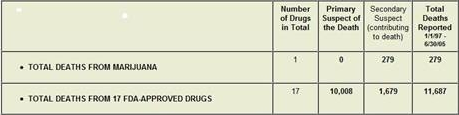
  • TOTAL DEATHS FROM MARIJUANA

1

0

279

279

  • TOTAL DEATHS FROM 17 FDA-APPROVED DRUGS

17

10,008

1,679

11,687

V. Chart of Deaths from Marijuana and 17 FDA-Approved Drugs
A. Marijuana

DRUG (Year Approved)

Primary Suspect of the Death

Secondary Suspect (contributing to death)

Total Deaths Reported
1/1/97 – 6/30/05

1. Marijuana (not approved)
also known as: Cannabis sativa L

0

109

109

2. Cannabis (not approved)
also known as: Cannabis sativa L

0

78

78

3. Cannabinoids
(unclear if these mentions include non-plant cannabinoids)

0

92

92

Sub-Total – Marijuana

0

279

279

FDA-Approved Drugs Prescribed in Place of Medical Marijuana

B. Anti-Emetics


DRUG
(Year Approved)

Primary Suspect of the Death

Secondary Suspect (contributing to death)

Total Deaths Reported
1/1/97 – 6/30/05

1. Compazine (1980)
also known as: Phenothiazine, prochlorperazine

15

30

45

2. Reglan (1980)
also known as: Metaclopramide, Paspertin, Primperan

37

278

315

3. Marinol (1985)
also known as: Dronabinol

4

1

5

4. Zofran (1991)
also known as: Ondansetron hydrochloride

79

76

155

5. Anzemet (1997)
also known as: Dolasetron mesylatee

22

5

27

6. Kytril (1999)
also known as: Granisetron hydrochloride

36

24

60

7. Tigan (2001)
also known as: Trimethobenzamide

3

15

18

Sub-Total – Anti-Emetics

196

429

625

C. Anti-Spasmodics


DRUG
(Year Approved)

Primary Suspect of the Death

Secondary Suspect (contributing to death)

Total Deaths Reported
1/1/97 – 6/30/05

1. Baclofen (1967)
also known as: Lioresal, 4-amino-3-(4-chlorophenyl)-butanoic acid

72

33

105

2. Zanaflex (1996)
also known as: Tizanidine hydrochloride, Sirdalud, Ternelin

46

23

69

Sub-Total – Anti-Spasmodics

118

56

174

D. Anti-Psychotics


DRUG
(Year Approved)

Primary Suspect of the Death

Secondary Suspect (contributing to death)

Total Deaths Reported
1/1/97 – 6/30/05

1. Haldol (1967)
also known as: Haloperidol, Haldol Decanoate, Serenace, Halomonth

450

267

717

2. Lithium (1970)
also known as: Lithium Carbonate, Eskalith, Lithobid, Lithonate, Teralithe, Lithane, Hypnorex, Limas, Lithionit, Quilonum

175

133

308

3. Neurontin (1994)
also known as: Gabapentin

968

302

1,270

Sub-Total – Anti-Psychotics

1,593

702

2,295

E. Other Well-Known and Randomly Selected FDA-Approved Drugs


DRUG
(Year Approved)

Primary Suspect of the Death

Secondary Suspect (contributing to death)

Total Deaths Reported
1/1/97 – 6/30/05

1. Ritalin (1955)
also known as: Methylphenidate, Concerta, Medadate, Ritaline
(used to treat ADD and ADHD)

121

53

174

2. Wellbutrin (1997)
also known as: Bupropion Hydrochloride, Zyban, Zyntabac, Amfebutamone
(used to treat depression & anxiety)

1,132

220

1,352

3. Adderall (1966)
also known as: Dextroamphetamine Saccharate, Amphetamine Aspartate, Dextroamphetamine Sulfate USP, Amphetamine Sulfate USP
(used to treat narcolepsy or to control hyperactivity in children)

54

12

66

4. Viagra (1998)
also known as: Sildenafil Citrate
(used to treat erectile dysfunction)

2,254

40

2,294

5. Vioxx (1999)
also known as: Rifecixub, Arofexx
(used to treat osteoarthritis and pain)

4,540

167

4,707

Sub-Total – Other Popular Drugs

8,101

492

8,593

F. TOTALS of A-E

Primary Suspect

Secondary Suspect

Total Deaths Reported
1/1/97 – 6/30/05

  • TOTAL DEATHS FROM MARIJUANA

0

279

279

  • TOTAL DEATHS FROM 17 FDA-APPROVED DRUGS

10,008

1,679

11,687


VI. Sources & Disagreement on Marijuana Deaths

Has marijuana caused any deaths?

General Reference (not clearly pro or con)

The Substance Abuse and Mental Health Services Administration’s (SAMHSA) 2003 report Mortality Data from the Drug Abuse Warning Network, 2001 (1.5 MB) stated:

“Marijuana is rarely the only drug involved in a drug abuse death. Thus … the proportion of marijuana-induced cases labeled as ‘One drug’ (i.e., marijuana only) will be zero or nearly zero.”
2003 – Substance Abuse and Mental Health Services Administration

PRO (Yes)

CON (No)

Thomas Geller, MD, Associate Professor of Child Neurology at the Saint Louis University Health Sciences Center, et al., wrote the following in their Apr. 4, 2004 article titled “Cerebellar Infarction in Adolescent Males Associated with Acute Marijuana Use,” (560 KB) published in the journal Pediatrics:

“Each of the 3 cannabis-associated cases of cerebellar infarction was confirmed by biopsy (1 case) or necropsy (2 cases)… Brainstem compromise caused by cerebellar and cerebral edema led to death in the 2 fatal cases.”
Apr. 4, 2004 – Thomas Geller, MD

Liliana Bachs, MD, Senior Medical Officer at the Norwegian Institute of Public Health, et al., wrote the following in their Dec. 27, 2001 article titled “Acute Cardiovascular Fatalities Following Cannabis Use,” published in the journal Forensic Science International:

“Cannabis is generally considered to be a drug with very low toxicity. In this paper, we report six cases where recent cannabis intake was associated with sudden and unexpected death. An acute cardiovascular event was the probable cause of death. In all cases, cannabis intake was documented by blood analysis… Further investigation of clinical, toxicologial and epidemiological aspects are needed to enlighten causality between cannabis intake and acute cardiovascular events.”
Dec. 27, 2001 – Liliana Bachs, MD

[Editor’s Note: Dr. Bachs clarified the findings from her Dec. 27, 2001 study reported above in a Nov. 28, 2005 email to ProCon.org, as quoted below.

“Causality is a difficult assessment in forensic toxicology. It is often an ‘exclusion diagnosis,’ and so it is in our cases. I’m therefore not sure about how to classify those deaths.

At the time I published that study I would probably not classify [the cannabis] as primary causation because it was not broadly accepted that [a death from cannabis] could occur at all. Today I see reports coming all the time that acknowledge cannabis cardiovascular risks, and the situation may be different.”]

Stephen Sidney, MD, Associate Director for Clinical Research at Kaiser Permanente, wrote the following in his Sep. 20, 2003 article titled “Comparing Cannabis with Tobacco — Again,” published in the British Medical Journal:

“No acute lethal overdoses of cannabis are known, in contrast to several of its illegal (for example, cocaine) and legal (for example, alcohol, aspirin, acetaminophen) counterparts…

Although the use of cannabis is not harmless, the current knowledge base does not support the assertion that it has any notable adverse public health impact in relation to mortality.”
Sep. 20, 2003 – Stephen Sidney, MD


Joycelyn Elders, MD, former US Surgeon General, wrote the following in her Mar. 26, 2004 editorial published in the Providence Journal:

“Unlike many of the drugs we prescribe every day, marijuana has never been proven to cause a fatal overdose.”
Mar. 26, 2004 – Joycelyn Elders, MD

VII. Full Text of All 20 FDA “Adverse Event” Reports

[Please note that some of these PDF files exceed 5 megabytes and may take several minutes to load]

  1. Adderall (PDF 495 KB)
  2. Anzemet (PDF 1.5 MB)
  3. Baclofen (PDF 755 KB)
  4. Cannabinoids (PDF 65 KB)
  5. Cannabis (PDF 330 KB)
  6. Compazine (PDF 1.6 MB)
  7. Haldol (PDF 1.5 MB)

  1. Kytril (PDF 2.2 MB)
  2. Lithium (PDF 2.4 MB)
  3. Marijuana (PDF 220 KB)
  4. Marinol (PDF 535 KB)
  5. Neurontin (PDF 6.3 MB)
  6. Ritalin (PDF 1.6 MB)
  7. Reglan (PDF 1.5 MB)

  1. Tigan (PDF 2.4 MB)
  2. Viagra (PDF 7.6 MB)
  3. Vioxx (PDF 31.5 MB)
  4. Wellbutrin (PDF 8.3 MB)
  5. Zanaflex (PDF 6556 KB)
  6. Zofran (PDF 1 MB)

SAN FRANCISCO REQUIRES THAT EVERYONE COMPOST

Sacramento Bee – San Francisco, renowned for its civic will to save the planet, is now ordering residents and businesses to compost food scraps and biodegradables, or risk fines for not properly sorting their garbage.

That’s welcome news for Jepson Prairie Organics, a Dixon-based composting firm that already accepts delivery of 400 tons a day in plate scrapings, greasy cardboard and other sweet-stinking waste from San Francisco eateries and homes.. . .

For some 200 Northern California vineyards that use it, there is something about San Francisco compost and its unique, urban blend of crab shells from Fisherman’s Wharf, pasta from North Beach, pupusas from the Mission District and dim sum from Chinatown that nourishes the soil like little else.

Yet the question for San Francisco is whether the new city composting law signed by Mayor Gavin Newsom last month will nourish the city’s ecological soul or merely irritate the populace.

The new law gives the city authority to fine residents and small businesses $100   and impose penalties up to $1,000 on big firms and apartment owners   if they refuse to segregate leftover fish bones, watermelon rinds and watercress salad into compost bins.

Even in liberal San Francisco, which boasts of recycling 72 percent of its 2.1 million tons of waste a year, a few residents wonder if the law is a case of big compost meets Big Brother. . .

The city, which has had a composting program since the mid-1990s, has achieved voluntary participation from 50 percent of restaurants, 40 percent of single-family homes and 20 percent of apartments.

But the new law, designed to boost those rates by using the threat of citations, is drawing national media attention. . .

“All of a sudden, the headlines were ‘Garbage Police: They’re coming,’ ” Newsom mused in a signing ceremony for the law passed on a 9-2 vote by the Board of Supervisors. . .

Dr. Bronner’s Ups Ante in Lawsuit Against ‘Organic’ Personal Care Cheaters

shampooDr. Bronner’s Magic Soaps filed its Second Amended Complaint today in San Francisco Superior Court against falsely labeled “organic” personal care companies that use non-organic pesticide-intensive agricultural and/or petrochemical material to make the main cleansing and moisturizing ingredients in their products. Defendants include, among others: Hain-Celestial (Jason “Pure, Natural & Organic; Avalon “Organics”); Levlad (Nature’s Gate “Organics”); Kiss My Face “Organic”; YSL Beaute Inc (Stella McCartney’s “100% Organic Active Ingredients”), Country Life (Desert Essence “Organics”); Giovanni “Organic Cosmetics”; and the certifiers Ecocert and OASIS.

Learn more

Oregon Passes Hemp Bill

According to an article on the Examiner.com, by a vote of 46 to 11, the Oregon House passed SB 676, a bill that permits production and possession of industrial hemp and trade in industrial hemp commodities and products.
Internet Resources:
Article on the Examiner.com

Soy May Protect Lungs from Chronic Disease

According to an article on the Times of India website, research shows consuming soy milk and tofu could cut down the risk of developing chronic obstructive pulmonary disease. The study was led by Curtin University of Technology’s Andy Lee and his colleagues from Curtin’s Health Innovation Research Institute (CHIRI) and representatives from four Japanese hospitals.
Internet Resources:
Article on the Times of India Website

California: Marijuana Smoke Added To State’s List Of Carcinogens

Sacramento, CA: The Office of Environmental Health Hazard Assessment (OEHHA) and the California Environmental Protection Agency have added marijuana smoke to the state’s list of official carcinogens, pursuant to Title27, California Code of Regulations, section 25305(a)(1).

Under state law, the Governor’s office is required to publish an annual list of chemicals that possess potential carcinogenic properties and/or are associated with reproductive toxicity, such as arsenic, lead, and tobacco smoke. Products containing such chemicals are required to carry warning labels. Business establishments with ten employees or more are also are mandated to post signs indicating whether there is a likelihood that an individual may be exposed to such chemicals while on the premises.

State environmental regulators determined that there is “limited” evidence “suggestive” that marijuana smoke exposure may be associated with an increased cancer risk in humans. Their review added, “[T]he similarities in chemical composition and in toxicological activity between marijuana smoke and tobacco smoke, and the presence of numerous carcinogens in marijuana (and tobacco) smoke, provide additional evidence of carcinogenicity.”

Presently, over 300 separate chemicals – including aspirin and alcoholic beverages – are designated as carcinogens under California law.

Labeling requirements for marijuana smoke will not take effect until June 2010. Neither marijuana nor edible products containing marijuana will be designated as carcinogens under state law.

Regulators made no official determination regarding the status of cannabis vapor, which does not contain combustion gases and has been determined to be a “safe and effective vehicle” for cannabis delivery in clinical trials.

Authors of the review did note that the largest population case-control study ever to assess the use of marijuana and lung cancer risk did not find a positive association between long-term cannabis smoking and cancer.

California NORML Coordinator Dale Geiringer said that the ruling did not come as a surprise because it has been well known for years that cannabis smoke contains known carcinogenic chemicals. However, he noted that the intake of these noxious chemicals “can be completely eliminated by vaporization or by consuming marijuana orally.”

NORML Deputy Director Paul Armentano said that it remains unclear what effect, if any, these new regulations will have on the dispensing of medical marijuana in California. “Since it is marijuana smoke, not marijuana per se, that is at issue here, it is not clear that legally operating medicinal cannabis dispensaries will have to alter their actions to comply with Prop. 65,” he said – noting that few such facilities allow patients to smoke cannabis on the premises. “Liquor stores are not required to post warnings on the premises just because they dispense alcohol, so why would medical cannabis dispensaries be treated any differently?”

The Gift of the Native Americans-America and the hidden future

A major aspect of its shadow that America must confront is its historically bad  treatment of people of color, including Native Americans — the first Americans. Four hundred years ago, the Hopi Indians had an ancient legend that they were to look to the East for the return of their “lost white brother” who had “gone to the East to develop, record and invent things”.  This lost white brother would bring the “missing stone tablet” to compliment the one the Hopis already had. The two complimentary halves of the stone tablet symbolize the head and the heart. The white culture developed a technological culture and the Native Americans developed a compassionate relationship to the earth.  The white culture developed the head and the Natives developed the heart, and these must be reunited if America is to fulfill her true spiritual destiny.

But the white man didn’t recognize his red brother when he first came to America, and he killed them and pushed them off the land they lived on.  This has created a heavy karma which is part of the national shadow that must be redeemed. Since Native Americans hold the power of nature in balance through their sacred ceremonies and dances, it is essential that we create right relationship with the original inhabitants of this land and protect the earth from pollution.  If we continue to mistreat the Native Peoples and their land, there will be karmic reaction from the forces within the earth to which they are deeply related.

But there was also something very important that was brought to America by the white race who came here several hundred years ago. They anchored the idea of freedom of religion to grow on this soil and spread to the world.  And most significantly, they brought the sacred sparks from the living flame of the Ageless Wisdom tradition–the hidden, initiate teachings at the core of the major religions. Our Founding Fathers (and Mothers) brought a profound metaphysical tradition with them that indicated a spiritual destiny for this nation.  This can unfold in the future if America grows into a wise and compassionate member of the community of nations, rather than being a selfish nation that dominates other nations through her superior power.

George Washington had a vision of an angel who showed him three great crises of the Republic.  But each time the Union triumphed against her enemies.  (This was reported in The National Tribune by Anthony Sherman who was with Washington at Valley Forge).