by Chris Bennet, illustrations by Ken Lee. Posted on Monday, August 31 1998 11:00:00 PM
http://www.cannabisculture.com/articles/1374.html
Holy pot has been smoked by Goddess worshippers since before history, and was first banned by those who sought to subjugate feminine spirituality

Part 5 of “When Smoke Gets in my I” a series on the history of cannabis and human consciousness.
In most ancient hunter-gatherer societies, women balanced the males’ supply of game with their collected harvest from the surrounding wilderness. Women therefore became the first to learn the secrets of plants, and how they propagated themselves.
This knowledge led to the development of agriculture, and the evolution from the animal totems of the hunter-gatherers to images of the Great Mother, who with proper worship produced her abundant harvest in the same way that women produced children.
Cannabis is among humanity’s oldest and most useful cultivated crops, and so it is not surprising to find that cannabis, in all its forms, has been intricately associated with Goddess worship in many cultures, throughout history.
Kali-Ma
The most ancient goddess still worshiped in the world today is the Indian Kali-Ma, the Mother of Life and Death. Her worship stretches back into pre-history, and is believed to predate that of her more well-known consort Shiva, the longest continually worshiped god on earth. Both Shiva and Kali are strongly associated with marijuana.
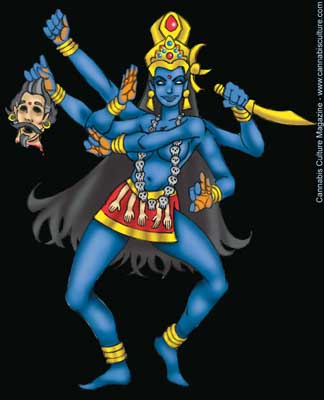
Kali is generally depicted with a girdle of human arms and a necklace of skulls, and represents the dark aspect of the goddess trinity of virgin-mother-crone. Both ancient and modern devotees of Kali partake of marijuana in various forms as a part of their worship.
Devotional ceremonies to Kali involve cannabis ingestion and ritual sex, which is directed at raising the Kundalini energy from the base of the spine up into the higher centres of the brain.

Other pot-goddesses
The worship of Kali, under various names, extended into the ancient Near East, and cannabis was also used by many of the worshippers of Kali’s ancient world counterparts.
Kali is the Hindu counterpart of the ferocious and sensual Canaanite goddess Anath, (part of a similar trinity with Ashera and Astarte)who is also described with “attached heads to her back, girded hands to her waist.”
In ancient Germany, marijuana was used in association with Freya, the slightly tamer Kali-like goddess of Love and Death.
Scythian Hempsters
It is generally accepted that it was the horseback-riding Scythians who spread the combination of cannabis and goddess worship throughout much of the ancient world.
Readers of part two in this series (CC#2) will remember that the Amazon-like Scythian women fought alongside their warrior mates, and that these “Hell’s Angels” of the ancient world were known to have used cannabis in funeral rites, doing so in veneration of their own variation of the Goddess Mother of Life and Death, Rhea Krona.
Showing cannabis’ strong ties with Scythian mythology, Rhea Krona came to reap her children in death with the scythe, an agricultural tool named for its Scythian origin, and originally designed for harvesting cannabis. This scythe image has survived through patriarchal times and into our modern day, with both Father Time and the Grim Reaper still carrying Rhea Krona’s ancient hemp-harvesting tool.
The Tree of Life
In a cave where an ancient urn was found that had been used by the Scythians for burning marijuana, there was also a massive felt rug, which measured 5 by 7 metres. The carpet had a border frieze with a repeated pattern of a horseman approaching the Great Goddess, who holds the Tree of Life in one hand and raises the other in welcome.
Imagery of the Goddess and the Tree of Life is also found amongst other cultures with whom the Scythians came into contact. Readers of part three in this series (CC#5) will remember that the ancient Canaanites and also Hebrews paid particular reverence to the Near Eastern Goddess Ashera, whose cult was particularly focussed around the use of marijuana.
According to the Bible itself, the ancient worshippers of Ashera included wise King Solomon and other biblical kings, as well as their wives and the daughters of Jerusalem. The Old Testament prophets often chastised them for “offering up incense” to the Queen of Heaven.
Like the imagery on the Scythian carpet, icons dedicated to Ashera also have depictions of a “sacred-tree”, most likely a reference to the cannabis that her followers grew and revered, using it as a sacrament, as a food and oil source, and also using the fibres in ritual weavings.
Eve: cultural hero
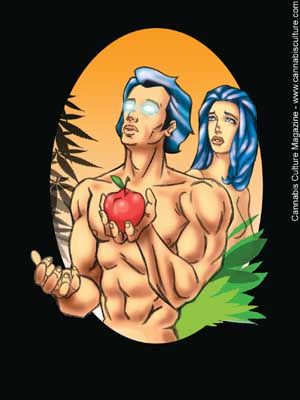
Among her other titles, Ashera was known as “the Goddess of the Tree of Life”, “the Divine Lady of Eden” and “the Lady of the Serpent”. Ashera was often depicted as a woman holding one or more serpents in her hands. It was Ashera’s serpent who advised Eve to disobey the male god’s command not to partake of the sacred tree.
The historical record shows that the Old Testament version of the myth of Eve, the serpent and the sacred tree was concocted as propaganda against pre-existing Goddess cults.
Originally, the outcome of the Eden myth was not tragic, but triumphant. The serpent brought wisdom, and after the magic fruit was eaten, Adam himself became a god. What was originally involved was probably a psychedelic sacrament, like the Elusian festival in Athens, in which the worshipper ate certain hallucinogenic foods and became one with the Mother Goddess Demeter.
Like the Tree of Life, the Tree of Knowledge was a symbol associated with the Goddess. The rites associated with her worship were designed to induce a consciousness open to the revelation of divine or mystical truths. In these rites cannabis and other magical plants were used, and women officiated as priestesses.
Roman Catholic Persecution
In early Christian times, the holy cannabis oil was ingested and used by many Gnostic Christian sects, in honour of the Queen of Heaven.
With the rise of one of the more harshly ascetic and anti-female Christian sects in Rome, and the subsequent development of the Roman Catholic Church, such groups were forced out of existence, along with most pagan religions and the cult of the Great Mother.
The new Church of Rome followed their Judaic predecessors in naming Eve (the representative of all women) the “Mother of Sin”, as well as demonizing magical plants.
Their violent purges of Goddess worship and magical plant use persisted into medieval times. It has been estimated that over a million female practitioners of the older Goddess religions were burned as “witches” for utilizing cannabis, mandrake, belladonna and other plants in their “flying ointments”.
Even medieval French heroine Joan of Arc was accused of using cannabis, mandrake and other plants in order to hear the voices which guided her, and this eventually led the church to commit her to the flames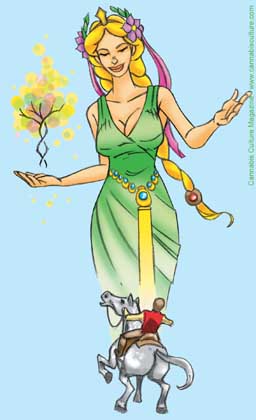
Marrying your Goddess
Similar to its use in the spiritual techniques of India, medieval European occult and alchemical masters used cannabis to aid in the “Marriage of the Sun and Moon” in the individual. The Sun and Moon represent the masculine and feminine aspects of the self.
Tantrik, Zoroastrian, Gnostic, Alchemical and occult literature all refer to “marrying your Goddess”, which means connecting an individual’s feminine and masculine aspects together into a unified force. This theme appears over and over again in medieval occult literature. Even the Gnostic Jesus states “when you make the male and female one and the same? then you will enter the kingdom.” (Gospel of Thomas)
Much like the woman’s liberation movement which has been taking place in our modern world, individual self completion requires a similar process to take place in our minds. The feminine aspect, or right cortex, becomes a full partner with the masculine aspect, or left cortex.
Marijuana use can greatly assist in this process. Is it any wonder then, that Shiva, the Lord of Bhang, was known as the god who was both man and woman? Or that the hashish eating Sufis, and later the American hippies, were both accused of being too feminine?
Love your mother
From the collected evidence it is clear that cannabis has been associated with worship of the Goddess since antiquity. Now, as we stand on the verge of a new millennia, in what seem to be the death throes of the patriarchy, it is as if the Goddess is once again reaching out her hand and offering her sacred Tree of Life to us in our time of collective need.
Like so many disobedient Eves, numerous female figures such as Elvy Mussika, Hilary Black, Mary Kane, Mountain Woman, The Holy Sisters of Hemp, Mama Indica, Brownie Mary and many others have decided to challenge the commandments of the male authorities and once again tempt us with the forbidden fruits of cannabis.
Indeed, it is likely not until we are once again free to enjoy all the sacred fruits of Mother Earth that the liberation of the feminine will fully take place, and we can restore Gaia, our planetary matriarch, back to health.
-|-
The androgynous nature of the human organism is re-emerging into consciousness in new ways that have evolved from past experience. We are learning to recognize and differentiate the opposites in our nature.
It makes no difference whether we call these opposites masculine and feminine, creative and receptive, knowledge and wisdom, competition and cooperation, explosion and implosion, or Logos and Eros. What is important, is that they be experienced in union as aspects of our own inner self. They are the self-renewing possibilities of our own individuality. Yoked together, they can fertilize each other to generate the creativity which is the potential of human beings.
The return of such female values as cooperation and forbearance is longed for in a world torn by war and threatened by nuclear disaster, poverty, disease and rape of the land. When the goddess of fertility is reunited with the god of consciousness, the renewed culture will have its conception.
? The Yoga of Androgyny, June Singer
-|-
Hymn To The Plants ? Rig Veda X.97.
Plants which as receptacles of light were born three ages before the Gods, I honour your myriad colors and your seven hundred natures.
A hundred, oh Mothers, are your natures and a thousand are your growths. May you of a hundred powers make whole what has been hurt.
Plants, as Mothers, as Goddesses, I address you. May I gain the energy, the light, the sustenance, your soul, you who are the human being.
Where the herbs are gathered together like kings in an assembly, there the doctor is called a sage, who destroys evil, and averts disease.
As they fell from Heaven, the plants said, “The living soul we pervade, that man will suffer no harm.”
The Herbs which are in the kingdom of the Moon, manifold with a hundred eyes, I take you as the best of them, for the fulfillment of wishes, as peace to the heart.
The plants which are queens of the Soma, spread over all the Earth, generated by the Lord of Prayer, may your energies combine within this herb.
-|-
How women are like pot.
There are some biological oddities which link cannabis with humans, especially the females of our species.
First, certain active compounds of marijuana have molecular resemblance to the female hormone estrogen. Possibly it is due to this aspect of cannabis’ genetic make-up that some growers have reported success with fertilizing their plants with birth control pills or menstrual fluid, the use of which as a ritual fertilizer goes back to the matriarchal period.
Of similar interest is that cannabis seeds contain rare gamma linoleic acid, found only in spirulina, two other rare seed oils, and human mother’s milk. As the tribal people of the world have always shown an incredible intuition when it comes to right use of plants, it is interesting to note that the Sotho women of South Africa make a mealy pap from hempseed to wean their babies off breast milk. 
Recommended Reading:
The Chalice & the Blade, by Riane Eisler
A History of Religious Ideas, by Mircea Eliade
Ishtar Rising, by Robert Anton Wilson
The Woman’s Encyclopedia of Myths and Secrets, by Barbara Walker
The Ritual Use of Cannabis Sativa: A Historical Ethnographic Survey, by WA Emboden (in Flesh of the Gods: The Ritual Use of Hallucinogens, Peter Furst, Ed)
Chris Bennet is the author of Green Gold: Marijuana in Magic and Religion, and the forthcoming Sex, Drugs and Violence in the Bible.