
Stephen Saunders – Experience and Background in Hemp and Cannabis Advocacy and Development

Stephen Saunders – Experience and Background in Hemp and Cannabis Advocacy and Development
Stephen learned how to grow medical marijuana from his father as he grew up, beginning in the early seventies.
As a musician and media developer, a search for the truth about this plant led him to work with Jack Herer to produce The Emperor Wears No Clothes for several editions and produce three editions of a CD-Rom version of the book, and usher Jack into the digital age by creating the first jackherer.com website. Stephen was also leading the media development at the Hempstead Company during it’s boom years and wrote and edited several technical papers on the subject. He produced an audio CD featuring Jack Herer rapping and music from many hemp activists. Produced and hosts electricemperor.com, the first online version of The Emperor Wears No Clothes. Successfully defended medical necessity in marijuana possession case in Michigan in 1998 by taking a case to jury trial in pro per, using Religious Freedom Act as basis. Appear in Public Service announcement urging the public to grow medicine featuring Jack Herer, and science fiction author George Clayton Johnson. Grows medical marijuana for personal use from seed using traditional hand cull and cure methods for two decades outdoors each season, old school.
See detailed list below. There’s still more, can’t remember them all…
After reading Jack Herer’s book, he began to apply his media development skills to the cause of Cannabis and Hemp Advocacy. His list of development and involvement in hemp culture related ventures include:
Founder of 0=2 Productions, Executive Producer and designer for Three editions of “The Electric Emperor” (CD-Rom version of Jack Herer’s famous Emperor Wears No Clothes.)
Executive and Music Producer, The Empilation CD, (a music cd featuring actual activists who are also musicians) performer and author of Woody Speaks for the Trees, and Jack Rap
Band performances in some of the first Cannabis “buyer’s clubs” in California.
The Hempstead Company (during the company’s boom years, contributed to attracting Woody Harrelson’s investment in the company) Head of Media and IT development, marketing consultant and product and packaging development, and initial phases of online presence development.
Developer of application forms and Identification cards for DrapJah ministries, a coptic church that advocated religious use.
Gathered signatures and worked directly with Jack Herer and the Proposition 215 campaign during its passing in California, as a Media Coordinator and Developer
Created identification cards, and 215 Statement Signs and other print media to support Proposition 215.
Editor of The Brawley Report put out by HempTec Industries documenting the first cultivation of hemp for industrial in the USA since the early fifties.
IT support and media development support for creating new editions of Jack Herer’s book with him.
Created and hosted and managed, media consulted and tutored to develop jackherer.com initially, got it started for Jack Herer, before it was taken over by Jeannie his wife, who is now a media development wiz.
Worked as organizer and support for Todd McCormick protests in Los Angeles.
Created and hosted, Electricemperor.com, the first online version of Jack’s book. This site is still live in it’s legacy form.
Wrote paper linking chronic marijuana smoking with malnutrition, presenting powerful proof of symbiosis between species.
Appear in Public Service announcement urging the public to grow medicine featuring Jack Herer, and science fiction author
George Clayton Johnson.
Grows medical marijuana for personal use from seed using traditional hand cull and cure methods for two decades outdoors each season, old school.
Startup web hosting and development for hempstar.com.
Tech developer for Bud Greene’s Bud Babes Network.
Currently developing agriculture growing formulas, including THUNDERgro™-Physics-Based Grow Potentiator, and ramping up botanicals production in California and Michigan, and running an IT/ WEB/Media Hosting and development company in California.
Became experienced in the production of various forms of Infusions, oils, and food products including Tofu made from Hempseeds.
Bred 14 proprietary Cannabis Strain Phenotypes.
Partnered with others in the development of Five Cannabis Collectives in California, along with five production facilities to support them.
Media and development support for numerous collectives.
IT/Web/Media Development for HEMJOBA,llc (hemjoba.com)
IT/Web/Media and Advisory Board for Full Spectrum Omega. (fullspectrumomega.us)
IT/Web/Media Development for Grandma Baker’s Edibles (grandmabakers.com)
Supported the healing of several patients from serious illnesses using Cannabis Compounds.
Currently Owner/Manager/Partner in HEMP2HEALTH, llc, a Colorado-based Cannabis and HEMP Production Company.
Proprietary CBD tincture formula development, HEMP2HEALTH,llc
Proprietary CBGD-based energy drink formulation.
Cannabis/HEMP Medical Industry Application IP development.
Senior Director, IT/Web/Media Developer at the Non-Profit Organization, Center For Enterprise and Community Development, Founder of the Pet Cancer Research Institute. (petcancer.us).
Consultant, Integrated Compliance Systems (icslv.com) a company which has developed a seed to vault system for the cannabis banking industry.
Consultant, Marisol Gardens, Maggie’s Farm.
Consultant, Member of Advisory Board, Pure Gold Cannabis Co.
Consultant, Member of Advisory Board, Precisions Cuts Cannabis Production.
Founder, Owner/Member, Summit Life Sciences, LLC.
Co-Founder, IT/WEB/media, and Business Development Partner, POTOPIA.
IT/WEB/media, and Business Development Partner, ERhollywood.net.
Business Development Consultant & Partner- Mrs. Green’s Remedies, LLC.
Headnotes – WTF!?

106 Courts 106II Establishment, Organization, and Procedure 106II(K) Opinions 106k106 k. Preparation and Filing. An opinion in prose the law does not demand, for judicial pronouncement may in poetry be if that suits the judge’s hand; metrical line is not perverse and rhyme will do just fine. Brown v. State, 216 S.E.2d 356 (1975)

DRUG- BUSTS this seems like it sucks, but maybe it is a step towards legitimization and “de-gangsterization”

Jennifer Squires, Santa Cruz Sentinel Medicinal marijuana caregivers may be prosecuted as drug dealers, according to a state Supreme Court ruling. The ruling upholds a Santa Cruz County Superior Court jury decision that found medicinal marijuana user Roger Mentch, 53, guilty of cultivating and possessing marijuana for sale. Mentch, who was arrested by sheriff’s deputies in 2003, claimed he was a caregiver for five medicinal marijuana patients. He also opened the Hemporium, a medicinal marijuana collective in Felton, where he sometimes sold the pot he grew. . . The court ruled primary caregivers must have an established care-giving relationship with the patient prior to providing that patient with medicinal marijuana, according to the decision. Also, primary caregivers can only provide pot to those patients, not sell the drug to other medicinal users or collectives. Therefore, Mentch’s sales to the Hemporium and another collective in the county amounted to dealing drugs

Junk Food may lead to Alzheimer’s symptoms

Reuters – Mice fed junk food for nine months showed signs of developing the abnormal brain tangles strongly associated with Alzheimer’s disease, a Swedish researcher said. The findings, which come from a series of published papers by a researcher at Sweden’s Karolinska Institutet, show how a diet rich in fat, sugar and cholesterol could increase the risk of the most common type of dementia. “On examining the brains of these mice, we found a chemical change not unlike that found in the Alzheimer brain,” Susanne Akterin, a researcher at the Karolinska Institutet’s Alzheimer’s Disease Research Center, who led the study, said in a statement. “We now suspect that a high intake of fat and cholesterol in combination with genetic factors … can adversely affect several brain substances, which can be a contributory factor in the development of Alzheimer’s.

Organic Bytes –

Vilksack’s nomination [for Agriculture Secretary] has now been withdrawn. Although Vilsack told the Des Moines Register he didn’t want to comment on why he had been sacked, sources at the Obama transition headquarters reported “a flood of calls and emails” from organic consumers opposing Vilsack’s nomination.

Read more about ..

AMERICAN TEENS LIE, STEAL AND CHEAT BIG TIME

Agence France Presse – American teenagers lie, steal and cheat more at “alarming rates,” a study of nearly 30,000 high school students concluded. The attitudes and conduct of some 29,760 high school students across the United States “doesn’t bode well for the future when these youngsters become the next generation’s politicians and parents, cops and corporate executives, and journalists and generals,” the non-profit Josephson Institute said. . .

Boys were found to lie and steal more than girls. Overall, 30 percent of students admitted to stealing from a store within the past year, a two percent rise from 2006. More than one third of boys (35 percent) said they had stolen goods, compared to 26 percent of girls.

An overwhelming majority, 83 percent, of public school and private religious school students admitted to lying to their parents about something significant, compared to 78 percent for those attending independent non-religious schools.

“Cheating in school continues to be rampant and it’s getting worse,” the study found. Amongst those surveyed, 64 percent said they had cheated on a test, compared to 60 percent in 2006. And 38 percent said they had done so two or more times.

Despite no significant gender differences on exam cheating, students from non-religious independent schools had the lowest cheating rate, 47 percent, compared to 63 percent of students attending religious schools.

Some 93 percent of students indicated satisfaction with their own character and ethics, with 77 percent saying that “when it comes to doing what is right, I am better than most people I know.”

MILITARY UPS ITS CIVILIAN ROLE

Spencer S. Hsu and Ann Scott Tyson, Washington Post – The U.S. military expects to have 20,000 uniformed troops inside the United States by 2011 trained to help state and local officials respond to a nuclear terrorist attack or other domestic catastrophe, according to Pentagon officials. . .

There are critics of the change, in the military and among civil liberties groups and libertarians who express concern that the new homeland emphasis threatens to strain the military and possibly undermine the Posse Comitatus Act, a 130-year-old federal law restricting the military’s role in domestic law enforcement. . .

The Pentagon’s plan calls for three rapid-reaction forces to be ready for emergency response by September 2011. The first 4,700-person unit, built around an active-duty combat brigade based at Fort Stewart, Ga., was available as of Oct. 1, said Gen. Victor E. Renuart Jr., commander of the U.S. Northern Command

Domestic emergency deployment may be “just the first example of a series of expansions in presidential and military authority,” or even an increase in domestic surveillance, said Anna Christensen of the ACLU’s National Security Project. And Cato Vice President Gene Healy warned of “a creeping militarization” of homeland security.

“There’s a notion that whenever there’s an important problem, that the thing to do is to call in the boys in green,” Healy said, “and that’s at odds with our long-standing tradition of being wary of the use of standing armies to keep the peace.”

The Review first started reporting on the militarization of American life in a 1996 story that began, “The nomination of General Barry McCaffrey as drug czar symbolizes the nation’s dramatic retreat from the principle of separation of military and civilian power. It further demonstrates the degree to which the Posse Comitatus Act of 1878 — which outlaws military involvement in civilian law enforcement — is being ignored and undermined by both the drug warriors and the Clinton administration. Disturbing as the McCaffrey appointment may be, however, it is only an unusually visible sign of something that has been going on quietly for a long time — the military’s steady intrusion upon, and interference with, civilian America.”

75 YEARS AGO AMERICANS WERE MUCH SMARTER; THEY REPEALED PROHIBITION

INDEPENDENT, UK – In selected watering holes across America, it’s party time tonight. In Washington, the festivities will centER on the venerable City Tavern in Georgetown; for $90, you can taste the cocktail offerings of the capital’s most expert bartenders (or “mixologists” as they like to term themselves), listen to a jazz band and, in the words of the invitation, “party like it’s 1933”.

In San Francisco, after a parade through the streets, celebrants will make their way to the 21st Amendment Brewery, gaining entrance to the revelries within by use of a special password. Similar events are being held in New York, Chicago, New Orleans and other US cities associated with an understanding acceptance of human frailty and having a good time.

By now the reason for these goings-on will be plain. Tonight is the 75th anniversary of the end of Prohibition – of 5 December 1933 when Utah became the deciding 36th state to ratify the 21st amendment to the constitution, and restore to the country’s citizens the basic human right to go out and have a drink.

Rarely in the annals of human experience has so well intentioned an idea been such a monument to failure as America’s 13-year attempt to eradicate the evil of alcohol. The National Prohibition (or Volstead) Act was passed by Congress in October 1919, overriding the veto of President Woodrow Wilson. The following January, the Act was ratified as the 18th amendment of the constitution after it had been approved by the required three-quarters majority of US states.

The “noble experiment”, as its supporters termed it, did indeed lead to a modest decline in alcohol consumption and an overall improvement in public health. But those meager and transient advantages were nothing compared to the unintended side-effects of Prohibition: a drastic decline in federal and state revenues, a surge in clandestine binge drinking and of course speak-easies, bootlegging, moonlighting and mobsters, not to mention the criminalization of millions of US citizens, including some its most eminent politicians, who were technically flouting the law of the land.

Ethan A. Nadelmann, Wall Street Journal – We should consider why our forebears rejoiced at the relegalization of a powerful drug long associated with bountiful pleasure and pain, and consider too the lessons for our time.

The Americans who voted in 1933 to repeal prohibition differed greatly in their reasons for overturning the system. But almost all agreed that the evils of failed suppression far outweighed the evils of alcohol consumption.

The change from just 15 years earlier, when most Americans saw alcohol as the root of the problem and voted to ban it, was dramatic. Prohibition’s failure to create an Alcohol Free Society sank in quickly. Booze flowed as readily as before, but now it was illicit, filling criminal coffers at taxpayer expense. . .

When repeal came, it was not just with the support of those with a taste for alcohol, but also those who disliked and even hated it but could no longer ignore the dreadful consequences of a failed prohibition. They saw what most Americans still fail to see today: That a failed drug prohibition can cause greater harm than the drug it was intended to banish.

Consider the consequences of drug prohibition today: 500,000 people incarcerated in U.S. prisons and jails for nonviolent drug-law violations; 1.8 million drug arrests last year; tens of billions of taxpayer dollars expended annually to fund a drug war that 76% of Americans say has failed; millions now marked for life as former drug felons; many thousands dying each year from drug overdoses that have more to do with prohibitionist policies than the drugs themselves, and tens of thousands more needlessly infected with AIDS and Hepatitis C because those same policies undermine and block responsible public-health policies.

And look abroad. At Afghanistan, where a third or more of the national economy is both beneficiary and victim of the failed global drug prohibition regime. At Mexico, which makes Chicago under Al Capone look like a day in the park. And elsewhere in Latin America, where prohibition-related crime, violence and corruption undermine civil authority and public safety, and mindless drug eradication campaigns wreak environmental havoc.

All this, and much more, are the consequences not of drugs per se but of prohibitionist policies that have failed for too long and that can never succeed in an open society, given the lessons of history. Perhaps a totalitarian American could do better, but at what cost to our most fundamental values?

Why did our forebears wise up so quickly while Americans today still struggle with sorting out the consequences of drug misuse from those of drug prohibition?

It’s not because alcohol is any less dangerous than the drugs that are banned today. Marijuana, by comparison, is relatively harmless: little association with violent behavior, no chance of dying from an overdose, and not nearly as dangerous as alcohol if one misuses it or becomes addicted. Most of heroin’s dangers are more a consequence of its prohibition than the drug’s distinctive properties. That’s why 70% of Swiss voters approved a referendum this past weekend endorsing the government’s provision of pharmaceutical heroin to addicts who could not quit their addictions by other means. It is also why a growing number of other countries, including Canada, are doing likewise.

World’s Oldest Marijuana Stash Totally Busted


Two pounds of still-green weed found in a 2,700-year-old Gobi Desert grave

By Jennifer Viegas
Discovery Channel
Wed., Dec. 3, 2008

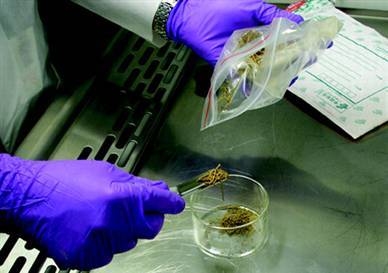
Stash for the afterlife: A photograph of a stash of cannabis found in the 2,700-year-old grave of a man in the Gobi Desert . Scientists are unsure if the marijuana was grown for more spiritual or medical purposes, but it’s evident that the man was buried with a lot of it.

Nearly two pounds of still-green plant material found in a 2,700-year-old grave in the Gobi Desert has just been identified as the world’s oldest marijuana stash, according to a paper in the latest issue of the Journal of Experimental Botany.
A barrage of tests proves the marijuana possessed potent psychoactive properties and casts doubt on the theory that the ancients only grew the plant for hemp in order to make clothing, rope and other objects.
They apparently were getting high too.
Lead author Ethan Russo told Discovery News that the marijuana “is quite similar” to what’s grown today.
“We know from both the chemical analysis and genetics that it could produce THC (tetrahydrocannabinolic acid synthase, the main psychoactive chemical in the plant),” he explained, adding that no one could feel its effects today, due to decomposition over the millennia.
Russo served as a visiting professor at the Chinese Academy of Sciences Institute of Botany while conducting the study. He and his international team analyzed the cannabis, which was excavated at the Yanghai Tombs near Turpan , China . It was found lightly pounded in a wooden bowl in a leather basket near the head of a blue-eyed Caucasian man who died when he was about 45.
“This individual was buried with an unusual number of high value, rare items,” Russo said, mentioning that the objects included a make-up bag, bridles, pots, archery equipment and a kongou harp. The researchers believe the individual was a shaman from the Gushi people, who spoke a now-extinct language called Tocharian that was similar to Celtic.
Scientists originally thought the plant material in the grave was coriander, but microscopic botanical analysis of the bowl contents, along with genetic testing, revealed that it was cannabis.
The size of seeds mixed in with the leaves, along with their color and other characteristics, indicate the marijuana came from a cultivated strain. Before the burial, someone had carefully picked out all of the male plant parts, which are less psychoactive, so Russo and his team believe there is little doubt as to why the cannabis was grown.
What is in question, however, is how the marijuana was administered, since no pipes or other objects associated with smoking were found in the grave.
“Perhaps it was ingested orally,” Russo said. “It might also have been fumigated, as the Scythian tribes to the north did subsequently.”
Although other cultures in the area used hemp to make various goods as early as 7,000 years ago, additional tomb finds indicate the Gushi fabricated their clothing from wool and made their rope out of reed fibers. The scientists are unsure if the marijuana was grown for more spiritual or medical purposes, but it’s evident that the blue-eyed man was buried with a lot of it.
“As with other grave goods, it was traditional to place items needed for the afterlife in the tomb with the departed,” Russo said.
The ancient marijuana stash is now housed at Turpan Museum in China . In the future, Russo hopes to conduct further research at the Yanghai site, which has 2,000 other tombs.
© 2008 Discovery Channel
URL: http://www.msnbc.msn.com/id/28034925/