

California: Assemblyman Introduces Measure To Regulate Marijuana Like Alcohol Proposal Will Raise Over $1.3 Billion Per Year, State’s Tax Collection Agency Says
San Francisco: State Assemblyman Tom Ammiano (D-San Francisco) introduced legislation this week to legalize and regulate the commercial production and sale of cannabis for adults age 21 or over. The proposal – Assembly Bill 390: The Marijuana Control, Regulation and Education Act – is the first bill ever to be introduced in the California legislature that seeks to tax and control the sale of cannabis.
Ammiano introduced AB 390 at a press conference Monday. Joining the assemblyman in support of the measure were Betty Yee, Chairwoman of the California Board of Equalization (Taxation), Oakland City Council member Rebecca Kaplan, Orange County Superior Court Judge James P. Gray (retired), and Dale Gieringer, Coordinator of California NORML, which provided legislative text and financial analysis for the bill.
“With the state in the midst of an historic economic crisis, the move toward regulating and taxing marijuana is simply common sense,” Ammiano said. “This legislation would generate much needed revenue for the state, restrict access to only those over 21, end the environmental damage to our public lands from illicit crops, and improve public safety by redirecting law enforcement efforts to more serious crimes. California has the opportunity to be the first state in the nation to enact a smart, responsible public policy for the control and regulation of marijuana.”
Local news anchors from CBS, ABC, NBC, and PBS television covered the press conference. National stories regarding Ammiano’s bill have appeared in USA Today, as well as on Air America and CNN.
As introduced, AB 390 would raise over $1.3 billion in annual revenue by taxing the retail production and sale of marijuana, according to financial estimates provided by the California Board of Equalization. An economic analysis by California NORML estimates that a legal, statewide retail market for cannabis could generate additional revenues totaling some $12 to $18 billion dollars per year.
The noncommercial cultivation of marijuana for personal use – defined as ten plants or fewer – would not be subject to taxation under the proposal. In addition, AB 390 would not alter existing legislation on the use of medicinal cannabis, nor would it impose new taxes or sanctions on the medical cultivation of cannabis.
A recent Zogby poll of 1,053 likely voters, commissioned by California NORML and Oaksterdam University, reported that nearly six out of ten respondents on the west coast favor taxing and legally regulating cannabis like alcohol.
“This bill is a winning proposition for California taxpayers,” Gieringer said. “It’s time that California stops wasting resources trying to enforce marijuana prohibition, and instead realizes the tax benefits derived from a legal, regulated cannabis market.”
For more information, please contact Dale Gieringer, California NORML Coordinator, at (415) 563-5858, or Paul Armentano, NORML Deputy Director, at: paul@norml.org. Additional information on AB 390, as well as contact information for the California Assembly, is available at: http://capwiz.com/norml2/issues/alert/?alertid=12758896.
California considers scrapping Marijuana Prohibition
AMERICA’S SLOW DRAG TOWARDS DRUG SANITY
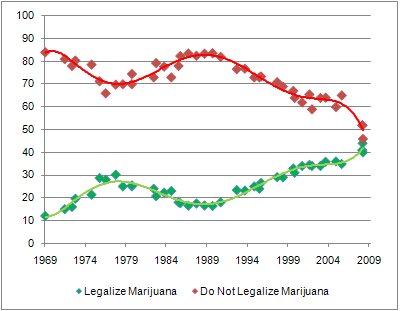
Three recent polls show that Americans are more sympathetic to the idea of legalizing marijuana than ever before. . . That all three polls show support for legalization passing through the 40 percent barrier may be significant. I compiled a database of every past poll I could find on this subject, including a series of Gallup polls and results from the General Social Survey, and could never before find more than 36 percent of the population (Gallup in October, 2005) stating a position in favor of legalization.
Marijuana and Multiple Sclerosis
…On the subject of “whether or not to grow more corn for Ethanol production and it’s global impact.
The debate has recently surfaced about whether or not grow more corn for the production of ethanol for fuel to replace petroleum.
I have four points to make on this.
1) It is ridiculously short-sighted to grow more of anythin we are already growing on what would be called a “mass” scale, especially when it comes to corn. Why? Well, there are 144,000 edible fruits and vegetables on the planet of which FOURTY FOUR are cultivated and distributed on any kind of “grand” scale. WHY ARE WE BEING SO BORING ABOUT THE FOOD WE CHOOSE TO CULTIVATE TO GROW!!?.
2) The two agricultural products produced in the greatest quantity on planet Earth currently, are:
CORN
and
BANANNAS.
It really ought to be RICE
and
Banannas.
Why is It CORN?
Because most of the corn that is grown for food is made into HIGH FRUCTOSE CORN SYRUP.
Sugar.
This product is jammed into MOST PROCESSED FOODS.
In the quantities that it exists in our food, it is UNHEALTHY for us and we don’t want it in our food, and a large percentage of us are victimized because do not even know we do not wish to have it in our foods!! It is unhealthy and even toxic.
Eliminate this from the food production chain and divert the corn production to ethanol production.
3) We do not have to use corn for fuel production to make fuel, WHY?
BECAUSE- if you make CELLULOSIC ethanol from the HEMP plant, also known as MARIJUANA, (the kind that does not get you high, though. More like the “leafy NO HIGH” version of pot) the fuel to feed ratio is 95% as compared to anything else you could use (ie. petroleum,corn,sugar,switchgrass, whatever…) which are all at about 45-64%. in the range of less than half.
WTF people!!!
TIME TO STEP UP TIME TO STEP UP!!!!
CARPE’ DIEM CARPE’ DIEM CARPE’ DIEM
Marijuana May Be Protective Against Injury, Study Says
Lausanne, Switzerland: The use of cannabis is not a contributing causal factor in injuries requiring hospitalization, and may even protect users against the likelihood of sustaining such injuries, according to the results of case-control study published online in the journal BMC Public Health.
Investigators at the Luasanne University Hospital in Switzerland assessed the association between the use of cannabis and/or alcohol and the risk of injury among 486 patients aged 16 and older.
Investigators reported: “Alcohol use in the six hours prior to injury was associated with [an elevated] relative risk compared with no alcohol use. Cannabis use was inversely related to risk of injury.”
Researchers also analyzed subjects’ drug use for the time period exactly one week prior to the patients’ hospitalization. They reported, “More patients reported alcohol use in the six-hour period prior to injury (case period) than in the corresponding six-hour period the previous week (control period). … For cannabis, fewer people reported use prior to injury (case period) than in the control period.”
Despite the study’s relatively small sample size, investigators concluded: “The results for cannabis use were quite surprising. … The present study in fact indicated a ‘protective effect’ of cannabis use in a dose-response relationship.”
Commenting on the study’s results, authors speculated that “cannabis is consumed in relatively safer, low risk environments” (e.g., at home) compared to alcohol, which is often consumed at bars or prior to going out in public.
A prior case-control study conducted by the University of Missouri also reported an inverse relationship between marijuana use and injury risk, finding, “Self-reported marijuana use in the previous seven days was associated … with a substantially decreased risk of injury.”
For more information, please contact Paul Armentano, NORML Deputy Director, at: paul@norml.org. Full text of the study, “Alcohol and cannabis use as risk factors for injury – a case-crossover analysis in a Swiss hospital emergency department,” is available online from BMC Public Health at: www.biomedcentral.com/1471-2458/9/40.
Who Was George Washington?
WASHINGTON – February 16 –
HARVEY WASSERMAN
Author of “Harvey Wasserman’s History of the United States,” Wasserman said today: “Washington inherited substantial riches from his wife Martha, the widow of Daniel Custis, a wealthy plantation owner who died when she was 26. She married George soon thereafter. He was (and is) often referred to as “the richest man in America,” but this title is in dispute. He was an aggressive land speculator who, as a British and then an American officer, did not hesitate to personally profit from the conquests of Indian land. Tax records show he owned more than a hundred slaves in his most prosperous years. Though he began to reject the ‘peculiar institution,’ and stopped buying more in his later years, he was also capable of selling off slaves he didn’t like or trust. At least two personal servants, Hercules and Oney Judge, ran away from his household. He freed a number of slaves when he died in 1799, pending Martha’s death. She died in 1802 after burning the personal letters in her possession (though some survived, including one complaining that their marriage lacked ‘fire between the sheets’).”
Wasserman recently wrote the piece “Was George Washington a gay pot smoker?” He added: “The evidence is also clear that Washington, like many other American farmers, grew significant quantities of hemp. It was (and is) a profitable and reliable cash crop, easy to grow, with no extraordinary demands for cultivation, watering or fertilizing. As a hardy perennial, it needs no year-after-year replanting, pesticides or herbicides. In one of his meticulous agricultural journals, dated 1765, Washington notes his being late in separating the male hemp plants from the female. There is little reason to do that except to make the females ripe for smoking. As a hard-working farmer, Washington would certainly be stunned to hear that hemp is today illegal in the nation he helped found.
“As an exceedingly complex and contradictory character, the Father of Our Country remains a topic of endless controversy and fascination. The last word on his attitudes toward slavery, his farming techniques and the details of his marriage will certainly be debated for centuries to come.”
More Information
California May Be Forced to Release Up to a Third of All Prisoners
February 10th, 2009
How will the private prison companies manage?
Via: Reuters:
Federal judges on Monday tentatively ordered California to release tens of thousands of inmates, up to a third of all prisoners, in the next three years to stop dangerous overcrowding.
As many as 57,000 could be let go if the current population were cut by the maximum percentage considered by a three-judge panel. Judges said the move could be done without threatening public safety — and might improve a public safety hazard.
The state immediately said it would appeal the final ruling to the U.S. Supreme Court.
Trend-setting California, the Golden State, has an immense prison system responsible for nearly 170,000 inmates, and their care has become a major political and budget issue as officials weigh multibillion costs of improved facilities against death and illness behind bars.
FANS BACK PHELPS
Washington Times – There’s a “Phelps backlash” out there. Fans and sympathizers have issued a cheeky call to boycott Kellogg’s, the cereal and snack mega-manufacturer that dropped the Olympic swimmer’s lucrative endorsement contract after his experience with marijuana became public a week ago.
“Kellogg’s has profited for decades on the food tastes of marijuana-using Americans with the munchies. In fact, we believe that most people over the age of 12 would not eat Kellogg’s products were they not wicked high,” reads a multipart petition written by Lee Stranahan, a Los Angeles writer and filmmaker.
Pop-Tarts, Cheez-Its and other junk-food favorites of marijuana users figure prominently in the drive, along with mentions of the “freaky” lifestyle of John Harvey Kellogg, who founded the company in 1906. Mr. Stranahan’s petition was featured Friday at the online Huffington Post and elsewhere.
Kellogg’s said it would not renew a lucrative endorsement contract, which will expire at the end of this month, with Olympic swimmer Michael Phelps after a photo was published of the athlete smoking marijuana. . .
Among the sponsors, Kellogg’s stands alone in its harsh judgment so far.
Others commercial backers — including Speedo, Omega and Visa — appear satisfied with Mr. Phelps’ public apology for “regrettable behavior” and “bad judgment,” which was made after a British tabloid published a photo of the record-breaking Olympic athlete smoking marijuana at a college house party in November.
None have canceled their reported million-dollar sponsorships.